The Tradetron Strategy Marketplace for US Traders: How It Actually Works

A strategy marketplace sounds like a shortcut: pick something that looks good, press subscribe, done. It is not that, and the older version of this post leaned too far that way. This rewrite says plainly what the Tradetron marketplace is for a US trader, what the statistics on it mean, and what to check before you run anything from it.
What is on the marketplace
Tradetron users who build strategies can publish them. A US listing shows the markets and instruments the strategy trades, the rules as the creator describes them, its backtest and, where the creator runs it live, its live record, and a subscription price set by the creator (free or paid). Listings are filterable by market, so a US trader can look at US stocks, ETFs and SPX, SPY, QQQ, NDX or XSP options only.
Under every statistic sits the same note: published by an independent user, not a Tradetron employee or adviser; not personalised advice; hypothetical or past results that do not guarantee future results. That note is not a formality. The person who published the strategy does not know you, your account size or your risk.
What subscribing does
When you subscribe, the strategy's rules are made available to your account. You then deploy it like your own strategy, choosing:
- Mode: Live Offline (live prices, every trade shown, no order sent) or Live Auto (orders to your connected broker).
- Broker account: one of your connected US brokers.
- Quantity: your contract or share count, independent of the creator's.
- Your own limits: the daily loss limit and other strategy-level settings you want on top.
The strategy then runs on Tradetron's servers for your account. Your orders go from your deployment to your broker. The creator's deployment and yours are separate: they can stop theirs, you keep yours; a change they publish does not alter your running copy until you redeploy.
What the creator sees, and does not
The creator sees how many subscribers they have and the subscription revenue. They do not see your name, your broker, your account, your orders or your P&L. There is no way for a creator to place an order in a subscriber's account. The relationship is a licence to run rules, nothing more.
How to read a listing before you subscribe
- Read the rules, not the curve. A good listing describes the entry, the legs, the exits and the time window in plain words. If you cannot tell what the strategy does from the description, do not run it.
- Check the markets and hours. Confirm the instruments are ones your broker offers with your approval level, and that the trading hours fit your account (US regular session, or an overnight SPX session).
- Treat every number as hypothetical. Backtests are hypothetical. A live record is past performance of the creator's deployment with their costs and fills, not yours.
- Look for the dates. A record that starts last month says less than one that spans a bad quarter.
- Plan your own test. Decide before subscribing how many weeks you will run it Live Offline and what would make you stop.
Run it Live Offline first
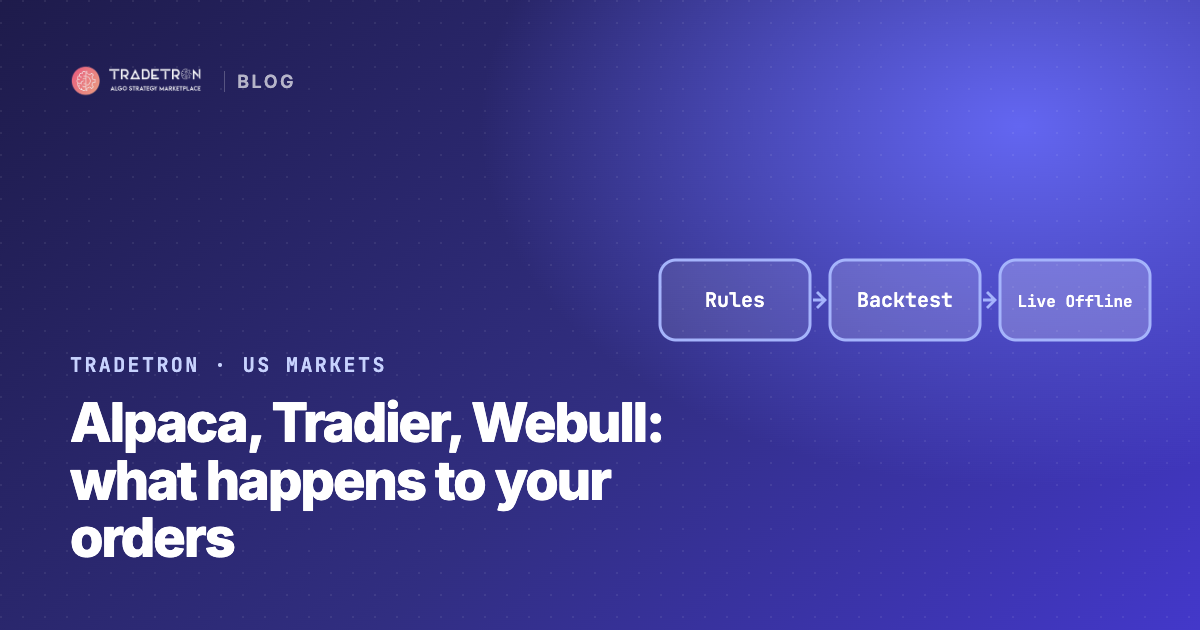
Every marketplace strategy can be deployed Live Offline: it runs on live US prices during the real session, shows every trade it would have placed and the P&L it would have had, and sends nothing to any broker. One Live Offline deployment is included on the free plan, with no broker and no card. Use it for weeks, not days; the point is to see the rules on a news day and on a quiet one. How to run a useful Live Offline test.
When you move a strategy to Live Auto, start with one contract. What happens to your orders once a broker is connected.
For creators: publishing to US traders
If you build a US strategy you want to publish, the listing needs a plain-English description of the rules, the instruments and the hours, and the hypothetical-performance note appears on it automatically. You set the price. You will see subscriber counts, not subscribers. Publishing is available from the Creator plan; the pricing page has the current tiers.
What the marketplace is not
It is not a fund: no money is pooled and nobody trades for you. It is not a signal service: nothing is sent to you to act on; your copy of the rules runs on its own. It is not advice: no listing is chosen for you, and the choice to run one is yours. It is a library of rules other users wrote, which you can run in your own account on your own terms. Read it that way and it is useful.
Frequently asked questions
Does Tradetron vet the strategies on the marketplace?
Listings must describe their rules and carry the hypothetical-performance note; Tradetron does not endorse, rank or recommend any strategy. The creator is responsible for the description; you are responsible for the decision to run it.
Can I change a marketplace strategy's rules?
You can set your own quantity, broker, mode and strategy-level limits. The rules themselves are the creator's; to change them you build your own strategy, which the builder makes possible without code.
Where is my money while a subscribed strategy runs?
At your broker, as always. Tradetron never custodies funds or securities, for your own strategies or for subscribed ones.