SPY ETF Dividend: Complete Guide for US Investors
The SPY ETF dividend is a cash payment made four times a year by the SPDR S&P 500 ETF Trust. It passes on the dividends paid by the roughly 500 companies in the S&P 500, minus the fund's expenses. SPY goes ex-dividend on the third Friday of March, June, September and December, and its yield has mostly sat between about 1% and 2% in recent years.

What is the SPY ETF?
SPY is the SPDR S&P 500 ETF Trust, launched in January 1993 as the first US-listed ETF. It holds the stocks of the S&P 500 index in index weights and is one of the most traded securities in the world, with very tight bid-ask spreads and a deep options market.
- 1993 the year SPY launched
- 0.0945% annual expense ratio
- 4 dividend payments a year
One detail matters for dividends: SPY is structured as a unit investment trust, not an open-end fund. A UIT cannot reinvest the dividends it receives from its holdings. It holds them as cash until the quarterly payout. In a rising market that small cash balance is a slight drag compared with funds like VOO or IVV, which track the same index, can reinvest along the way, and charge lower fees (0.03%). SPY's edge is liquidity, which matters most to traders and options users.
How the SPY dividend works
- Companies pay dividends to SPY throughout the quarter as the fund's holdings declare them.
- SPY collects the cash and deducts its expenses.
- The fund declares a distribution per share for the quarter.
- Ex-dividend date: you must own SPY before this date to get the payout. The share price opens lower by roughly the dividend amount.
- Payment date: the cash lands in your brokerage account, usually at the end of the month after the ex-date.
| Quarter | Ex-dividend date (usual) | Payment (usual) |
|---|---|---|
| Q1 | Third Friday of March | End of April |
| Q2 | Third Friday of June | End of July |
| Q3 | Third Friday of September | End of October |
| Q4 | Third Friday of December | End of January |
Exact dates shift with weekends and holidays. Check the fund's distribution calendar before you plan around one.
SPY dividend yield: why it changes
Yield is the last twelve months of dividends divided by the current share price.
The dividend amount itself depends on what the S&P 500 companies pay. Two things have kept the index yield low in recent years: the largest companies by weight are technology firms that pay small dividends relative to their share price, and many companies return cash through buybacks rather than dividends. Quarterly payments also vary. The March quarter is often smaller than the December quarter because of when companies pay.
Price return vs total return
If you look only at the SPY price chart, you miss the dividends. Total return assumes every dividend is reinvested in more shares.
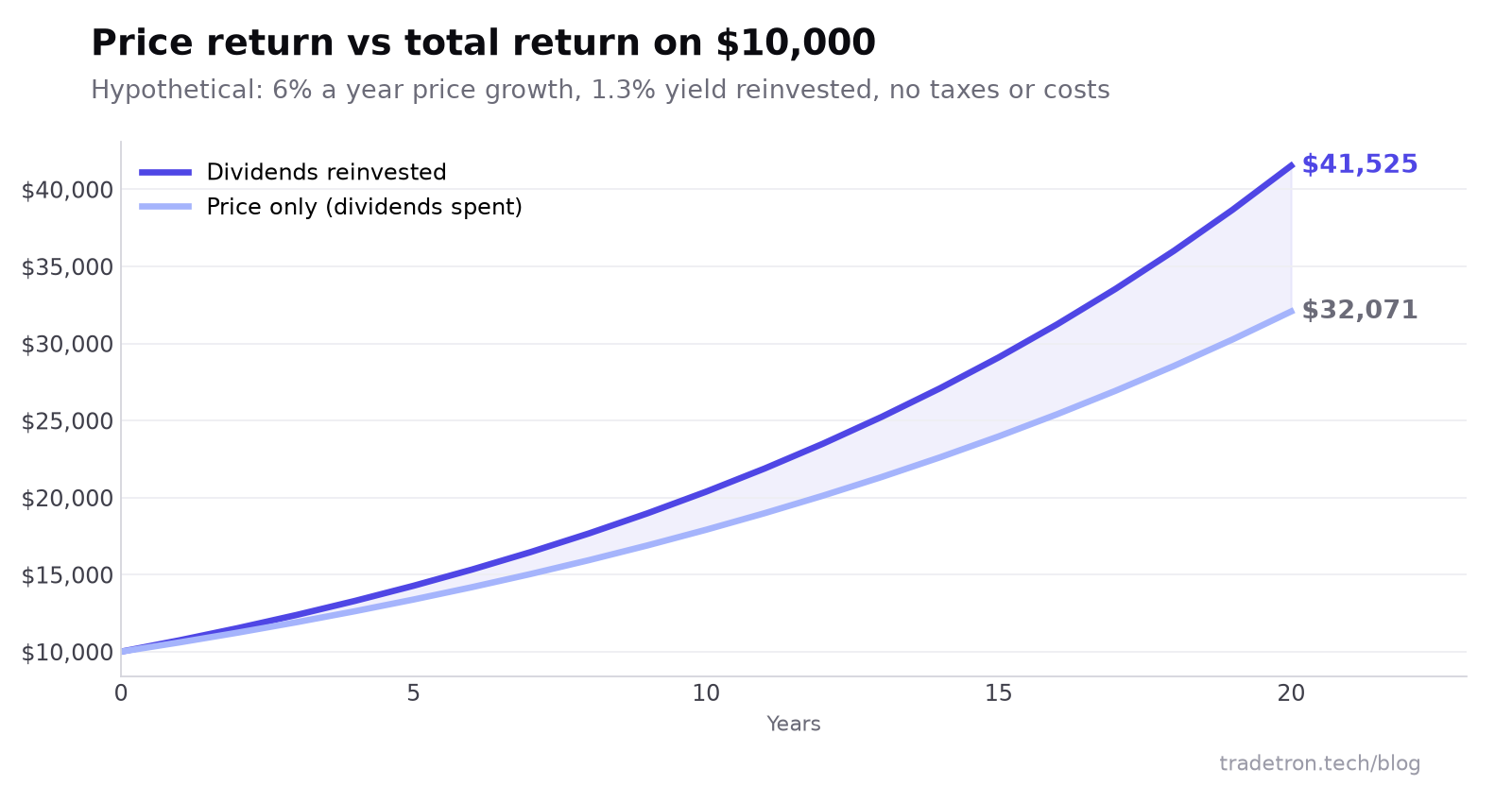 Hypothetical example: reinvesting a 1.3% yield adds up over 20 years
This is why backtests and performance comparisons should use total return (or adjusted prices) for SPY. A strategy that holds SPY and is measured on price alone looks worse than it is; one that sits in cash and is compared with SPY's price alone looks better than it is.
How SPY dividends are taxed (US investors)
- Qualified dividends are taxed at long-term capital gains rates: 0%, 15% or 20% depending on your taxable income. To qualify, you must hold SPY for more than 60 days during the 121-day window that starts 60 days before the ex-dividend date.
- Non-qualified (ordinary) dividends are taxed at your regular income tax rate. A portion of SPY's payout can fall in this bucket each year; your Form 1099-DIV shows the split.
- Net investment income tax of 3.8% can apply on top for higher incomes.
- State tax may apply depending on where you live.
- Tax-advantaged accounts such as an IRA or 401(k) defer or avoid the tax on dividends while they stay in the account.
Does dividend capture work on SPY?
Dividend capture means buying just before the ex-date, collecting the payout, and selling soon after. On SPY it usually disappoints:
- The price drops by roughly the dividend on the ex-date, so you are not getting anything for free.
- If you hold for less than the qualifying period, the dividend is taxed as ordinary income.
- A quarterly payout is a small slice of the share price, so spreads, slippage and a normal day's price move can easily outweigh it.
If you want to test the idea anyway, test it with total-return data and realistic costs, not on price charts alone.
Options and the SPY dividend
SPY options are American style, so they can be exercised any day before expiry. That creates one dividend trap worth knowing:
Covered calls on SPY (owning 100 shares and selling a call against them) are a common way to add option premium to the dividend. They also cap your upside above the strike, so they change the shape of returns rather than adding free income.
Inverse and leveraged S&P 500 ETFs are not a dividend play
Around SPY there is a family of products that track the S&P 500's daily move at a multiple: inverse (-1x), leveraged (2x, 3x) and leveraged inverse (-2x, -3x). They exist for short-term trading and hedging, not for income.
| Product type | Daily goal | Typical use |
|---|---|---|
| Plain S&P 500 ETF (SPY, VOO, IVV) | 1x the index | Long-term holding, income, core position |
| Inverse ETF | -1x the daily move | Short-term hedge or bearish trade |
| Leveraged ETF | 2x or 3x the daily move | Short-term momentum trades |
| Leveraged inverse ETF | -2x or -3x the daily move | Short-term bearish trades |
Because these funds reset every day, their results over weeks can drift far from "2x" or "-1x" of the index's move:
That's why they suit rules with a defined holding period and hard exits. For how traders use the inverse side, read inverse SPY ETFs: how traders profit when the S&P 500 falls.
Building a rules-based SPY plan
Most SPY holders do best with something simple: buy regularly, reinvest dividends, hold for years. Traders who want more structure usually write down rules like these:
- Trend filter: hold SPY while it closes above its 200-day moving average; move to cash (or a hedge) when it closes below.
- Core plus hedge: keep a core SPY position and add a small inverse-ETF hedge only when a defined drawdown or volatility level is hit, with a rule for removing it.
- Covered calls: sell a call against each 100 shares at a set distance from the price, and close or roll it before the quarterly ex-date if it is in the money.
- Dividend-aware rebalancing: reinvest each payout on a fixed schedule rather than letting cash pile up.
Every one of these is a rule you can test. Write it in plain English first, then check it on historical data before you trust it.
For more on investing in the index itself, see how to invest in the S&P 500 index, and for a full rules-based approach to US markets, read how to build a US market strategy.
Frequently asked questions
How often does SPY pay dividends?
Four times a year. SPY usually goes ex-dividend on the third Friday of March, June, September and December, and pays near the end of the following month (April, July, October and January).
What is the SPY dividend yield?
It is the last twelve months of dividends divided by the share price. In recent years it has mostly been between about 1% and 2%. It falls when the price rises faster than the dividends, so check a current quote for today's figure.
How much does SPY pay per share?
It varies every quarter, because it passes on whatever the S&P 500 companies paid during that quarter, minus expenses. The fund publishes each distribution amount when it is declared.
Are SPY dividends qualified?
Most of SPY's dividend is usually qualified, taxed at 0%, 15% or 20% in a US taxable account, provided you held the shares for more than 60 days in the 121-day window around the ex-date. Your Form 1099-DIV shows the qualified and non-qualified split.
Does SPY reinvest dividends automatically?
The fund itself doesn't: as a unit investment trust it pays dividends out in cash. Your broker can reinvest them for you if you turn on a dividend reinvestment plan (DRIP).
Is SPY or VOO better for dividends?
Both track the S&P 500 and pay similar dividends. VOO has a lower expense ratio and can reinvest dividends inside the fund between payouts, which slightly favours long-term holders. SPY has far more trading volume and a deeper options market, which favours traders.
Do inverse or leveraged S&P 500 ETFs pay dividends?
Some make small distributions, but they are not income products. They aim for a multiple of the index's daily move and are built for short-term trading, so judge them on that, not on yield.