Inverse SPY ETF: How Traders Profit When the S&P 500 Falls
An inverse SPY ETF is a fund that aims to deliver the opposite of the S&P 500's return for a single day: if the index falls 1%, a -1x inverse ETF aims to rise about 1%. Traders use them to hedge a long portfolio or take a short-term bearish view without short-selling. Because they reset daily, they are built for short holding periods, not long-term investing.
How an inverse SPY ETF works
Strictly speaking, these funds don't track SPY itself. They track the S&P 500 index, the same index SPY holds, using swaps and futures to produce the opposite of each day's return.
| Type | Daily target | Examples |
|---|---|---|
| Inverse | -1x the S&P 500 | ProShares Short S&P500 (SH) |
| Leveraged inverse | -2x | ProShares UltraShort S&P500 (SDS) |
| Leveraged inverse | -3x | ProShares UltraPro Short S&P500 (SPXU), Direxion Daily S&P 500 Bear 3X (SPXS) |
These funds also charge noticeably higher expense ratios than plain index ETFs, which adds a small drag the longer you hold them.
The daily reset: why longer holds drift
Each day the fund rebalances to hit its target for the next day. Over several days, returns compound from a new base each time, so the result depends on the path the index took, not just where it ended.
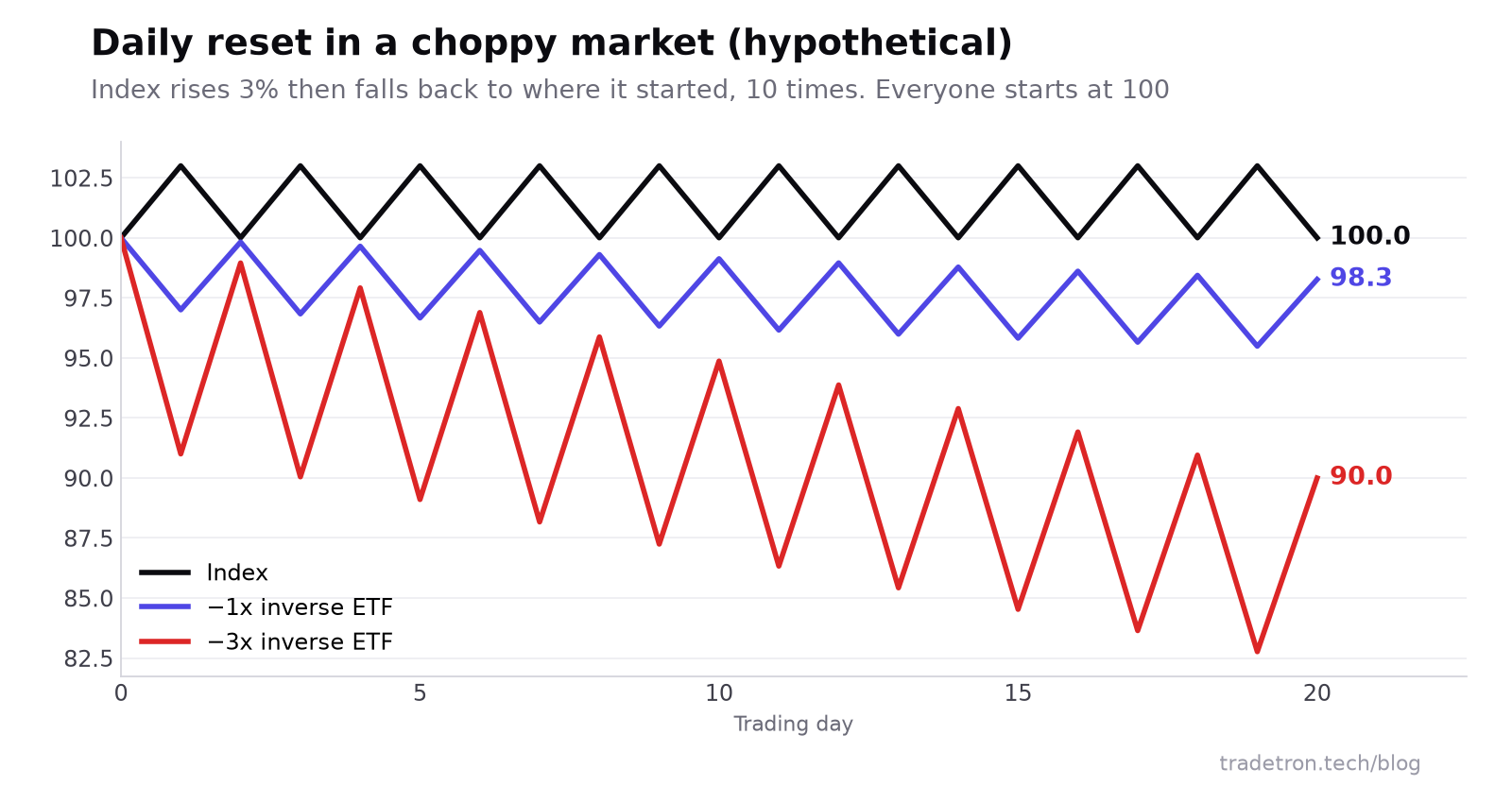 Hypothetical path: the index ends flat, the inverse funds don't
The drift can also work in your favour. In a steady decline it compounds the other way:
| Index path (10 trading days) | Index result | -1x fund | -3x fund |
|---|---|---|---|
| Falls 1% every day | −9.6% | +10.5% | +34.4% |
| Up 3%, back to start, 10 times | 0% | −1.7% | −10.0% |
These are arithmetic examples before fees, not forecasts. The lesson is the same either way: inverse ETFs behave as expected over a day, and over longer periods they reward steady trends and punish chop.
Why traders use inverse S&P 500 ETFs
- Hedging a portfolio. If you hold US stocks and expect a rough patch, an inverse ETF can offset part of the fall without selling your holdings (and triggering taxes on them).
- Short-term bearish trades. Taking a view on a pullback without opening a margin account to short shares.
- Defined maximum loss. Unlike shorting, you can't lose more than you put into the ETF.
- Simplicity. It trades like any stock, in any brokerage account that allows ETFs.
How big should a hedge be?
Inverse ETF vs the alternatives
| Inverse ETF | Bought put option | Put spread | Short S&P 500 futures | |
|---|---|---|---|---|
| Maximum loss | What you invest | The premium | The net premium | Unlimited without a stop |
| Drift or decay | Daily-reset drift | Time decay | Lower time decay | None from structure |
| Account needs | Any account | Options approval | Options approval | Futures account and margin |
| Best for | Short holds, simple hedges | Event protection | Cheaper defined protection | Larger, active hedgers |
You can also build a synthetic short with options: sell an at-the-money call and buy an at-the-money put with the same strike and expiry. It behaves like a short futures position. It isn't defined risk, though: the short call loses without limit if the market rallies, so it needs a stop.
A rules-based way to trade inverse ETFs
Inverse ETFs suit rules because the main risk, holding too long, is a decision you can take out of your own hands.
Test a template like this on several years of history, including the choppy periods, and compare its cost in good years with its protection in bad ones. A hedge that costs more than it saves isn't doing its job.
For the long side of the same index, read our SPY ETF dividend guide. For hedging in general, see what hedging is and how to automate it.
Frequently asked questions
What is an inverse SPY ETF?
It is an ETF designed to move opposite to the S&P 500 for one day. A -1x fund aims to rise about 1% when the index falls 1%. Leveraged versions target -2x or -3x the daily move.
What is the inverse ETF of SPY?
There isn't one fund that inverts SPY itself, but several inverse ETFs track the S&P 500 index that SPY holds. ProShares Short S&P500 (SH) targets -1x the daily move; SDS targets -2x; SPXU and SPXS target -3x.
Can you hold an inverse ETF long term?
It's generally not what they are built for. Because they reset daily, returns over weeks or months can differ a lot from the opposite of the index's move, and the gap grows with volatility and leverage. Most fund documents describe them as short-term tools.
Is buying an inverse ETF the same as shorting SPY?
Not quite. For a single day the exposure is similar, but shorting has no daily reset, can lose more than you invested, and needs a margin account. An inverse ETF's loss is limited to what you put in, but it drifts over longer holds.
Are inverse ETFs good for hedging?
They can be, for short periods. They are simple and need no options or margin approval. For longer protection, many traders prefer put options or put spreads, which have a known cost and no daily reset.
Can I automate inverse ETF trades?
Yes. On Tradetron you can set an indicator or price signal for entry, a stop, a maximum holding time and an exit rule, backtest them, and run them Live Offline before trading through a connected US broker.